 Donald Miller and the Democractic National Convention
Tuesday, August 26, 2008
Many of you know of author Donal Miller. He's most known for his work Blue Like Jazz, but most recently, he's been known for giving the benediction at the Democratic National Convention's opening night in Denver just this past Monday. It's been less than a day since the video has been up on YouTube, yet it's been played 910 times already (as of 11:45am).
Here's a challenge: take some time, and meaningfully read through the comments others have posted. Think about them and ask yourself if you agree with Donald Miller's prayer or if other things need to happen as well. Take some time to get read up on the issues.
Below is the actual video. You can see the prayer in written form via Donald Miller's website, at donaldmillerwords.com.
Posted By: Anonymous at 11:35 AM : Link : 1 Comments
We Are Made In The Image Of God
Thursday, August 21, 2008
Genesis 1:26-31
26 Then God said, "Let us make man in our image, in our likeness, and let them rule over the fish of the sea and the birds of the air, over the livestock, over all the earth, [b] and over all the creatures that move along the ground."
27 So God created man in his own image,
in the image of God he created him;
male and female he created them.
28 God blessed them and said to them, "Be fruitful and increase in number; fill the earth and subdue it. Rule over the fish of the sea and the birds of the air and over every living creature that moves on the ground."
29 Then God said, "I give you every seed-bearing plant on the face of the whole earth and every tree that has fruit with seed in it. They will be yours for food. 30 And to all the beasts of the earth and all the birds of the air and all the creatures that move on the ground—everything that has the breath of life in it—I give every green plant for food." And it was so.
31 God saw all that he had made, and it was very good. And there was evening, and there was morning—the sixth day.
Read and reflect on the above Scripture. Read through it slowly, and focus specifically on verse 27. Say the verse a few times over in your head. Once you've done that, ask your self the following question:
What does it means to be made in God’s image?
God has been dealing with me in this area a lot over the past few weeks, and, honestly, it's been awesome. The coolest thing is that God has not only been showing me his character, but he's been showing me why knowing his character is so important.
Read through the following Scriptures, and pay close attention to every word that describes who God is.
Exodus 34:5-7
Galatians 5:22-23
1 John 1:5
1 John 4:7-10, 16
Make a list of the characteristics you see, and meditate on them. What sticks out to you?
How To Live Life In God’s Image
Gordon Fee and Douglas Stuart, in their book How To Read The Bible Book By Book, talk a lot about what it means to be made in God’s image. They say that there are three implications because man was made in God’s image:
1. Man got to know God’s character and what he was like
2. Man enjoyed fellowship and communion with God
3. God’s character was embedded in man
However, as a result of the Fall, these things were all messed up, including the likeness of God in man:
“…the Fall also caused us to distort-and blur-the divine image in ourselves, rolling it in the dust, as it were. Instead of being loving, generous, self-giving, thoughtful, merciful-as God is-we became miserly, selfish, unloving, unforgiving, spiteful. Created to image, and thus represent, God in all that we are and do, we learned rather to bear the image of the Evil One, God’s implacable enemy” (Stuart and Fee, How To, pg 16).
As I said before, the great thing about God dealing with me in this area is not only the fact that He's showing me who He is, and what He's like, but He's showing me why it's so important to know all this.
Simple reason: God calls us to reflect His character to the world around us. The image God made us in is what we're called to show to everyone. Don't believe me? Read this:
But just as he who called you is holy, so be holy in all you do; for it is written: "Be holy, because I am holy." (1 Peter 1:15-16)
Notice, the reason why God calls us to be Holy is because it is who He is. It is His essence and His character, and thus, we are called to be like Him.
Take time to continually reflect on God's likeness, and figure out how you can grow and become more like Him.
Posted By: Anonymous at 3:20 PM : Link : 0 Comments
Ear Candy
Friday, August 15, 2008
For those of you who lack observation skills, or if you just plain didn't look at all, if you go back to the home page, and look in the bottom left hand corner, you should find two sermons for your listening pleasure (and of course for your growth).
The top message is by Aaron White who works for the 614/War College in Vancouver, BC. This message was given on prayer at CBLI (Central Bible Leadership Institute) only a few weeks ago. It comes straight from John 17. Listen up, take notes, and get ready!
The second message is by Steve Chalke. He is the chair of STOP THE TRAFFIK (a very well known and respected initiative that fights human trafficking world wide) and was appointed as a special advisor for the United Nations on human trafficking. His message, centered mostly on Genesis 1 and humans being made God's image, will definitely stir you up if you listen in.
Glory to God!
Posted By: Anonymous at 4:39 PM : Link : 0 Comments
New Worship Songs Added
Good news fellow worshipers! New songs have been added to both the Salvation Army Song Book and Contemporary Praise and Worship sections of MetroYouthNetwork's worship resources. They all come from the Teen and Young Adult Track's worship binders from CBLI 2008. So, log in, download the lead sheets and get worshiping!
Not a member of MetroYouthNetwork's worship resources? No worries. Click the Worship tab on the home page, and then follow the instructions there. It's easy, quick and hassle free.
Here's the new song list:
Salvation Army Song Book:
A Mighty Fortress Is Our God (SASB #1)
He Giveth More Grace (SASB #579)
I'll Go In The Strength Of The Lord (SASB #734)
Take My Life And Let It Be (w/ new chorus; SASB #525)
Contemporary Praise And Worship:
Awesome Is The Lord Most High
Everlasting God
Glorious
Lead Me To The Corss
Lord Make Calvary Real To Me
Love Is All
More Than Life
My Future Decided
When God Comes Near
Yahweh Is For Us
Yours Is The Kingdom
Posted By: Anonymous at 10:36 AM : Link : 0 Comments
Background of Old Testament Prophecy
Wednesday, August 13, 2008
Just this past Sunday I gave a Message on Amos 5. The coolest part was reading up on the role of prophets in the Old Testament. I thought I'd share that with you all. Just for you information, I read How To Read The Bible For All Its Worth, and How To Read The Bible Book By Book, both by Gordon Fee and Douglas Stuart. Look them up!
1. The Role of a Prophet – Covenant Enforcement Mediators
The main subject of a prophet’s message was the covenant-Law. The covenant-law was given to Israel through God’s first prophet Moses so that as they kept it they would be “reshaped” into the God’s image/likeness, which was lost as a part of the Fall (How To Read The Bible Book by Book, pages 14-17). Thus, as covenant enforcement mediators, the prophets were always recalling
-Taking care of the poor and needy come from Ex. 22:21-27 (giving and lending); Dt. 16:18-20 (justice in the courts), 24-17-22 (leaving food behind in the fields for the poor)
2.Common Misconceptions of the Law
Most people think that the Law is nothing more than rules to be kept while a heavenly cop waits to bust
2. God’s character was imbedded in us
But as a result of the fall, both of those things were distorted. Man’s view of God was marred, as was God’s likeness in man. So, when God gave the Law to Moses, it was with the intention of revealing his character to them as well as remolding them into his likeness. For instance, Leviticus 19:2 says, “Be holy, because I, the Lord your God, am holy.” This is who I am, be like me.
Stuart and Fee write: “Thus he gave them the Law as his gift to them, both to reveal what he is like and to protect them from one another while they were being reshaped” (How To Read The Bible Book By Book, pg 17).
3. Understanding Oracles
Reading the OT Prophecies can be a little weird because of their structure and organization. What we need to keep in mind is that the prophetic books are merely written prophets. That is to say that there were many prophets in
4. Specific Situations
We need to understand that God was speaking to a specific context, a certain happening, while this certain person was King, or while
Posted By: Anonymous at 4:05 PM : Link : 0 Comments
Summer Missions Team 2008
Tuesday, August 12, 2008
For those of you who went to CBLI just a few weeks ago, you may remember the worship meeting that featured the Summer Mission Teams from this summer. You also may remember a video that tried to sum up their experience. For your viewing pleasure, here it is:
Summer Mission Team 2008 Music Video from Salvationdave on Vimeo.
Posted By: Anonymous at 8:56 AM : Link : 0 Comments
Glory To God
Friday, August 08, 2008
Sad to say, I know, but summer will soon come to an end, and the Fall will quickly kick in full swing. Many of us have recently returned from awesome trips in the United States and even from around the world. Even as I speak, I know some are still away on trips (Chicago Temple has gone/will be going to New York). After having had some time to process and unwind, are you ready for what's to come? More accurately, are you ready to continue serving God and loving Him when school starts and work hits again?
One of the most fundamental issues of our Army missions trips is to equip people with tools to minister and live out the Gospel holistically, which means at all times and in all places. In other words, we should be able to love Jesus anywhere we are, not just during our summer get-aways.
There is often an unfortunate disconnect between our summer destinations and our primary context. Most people find it easy to serve and grow during summer trips, and rightfully so in some respect: we are constantly surround by a group of believers, and thus are (usually) constantly encouraged to keep going in all we do. Yet when the trip is over, and the feelings gone, people often take an unnecessary hiatus from pure missional living, and this should not be the case.
I understand that when we come off "the field" (a term that is often only referred to as the place where you go to serve, when in actuality the field is everywhere; it's wherever you go) that we come back to new and old struggles alike. But we have to live faithfully wherever we are, and that includes every family relationship, school responsibility, and Corps ministry.
Do you realize what the root problem of this is? Compartmentalizing. In other words, we live Godly lives at certain times and places, but not in all. It's living holy/wholly for God during the summer, but letting things slide during the school year. It's deciding to memorize the Word because that's what you do on a mission team, but it takes too much time because I have a lot of homework. It's talking to anyone and everyone about the love of God during the Summer, but not sharing it with person next to you, or talking to the homeless person you just passed, or taking time out of your day to talk to that perfect stranger because, well, it's a different time.
Know that God calls us to to love God and our neighbor at all times, in all places, and in every way. So give glory to God, wherever you go.
[Matthew 22: 37-40]
Jesus replied: " 'Love the Lord your God with all your heart and with all your soul and with all your mind.'This is the first and greatest commandment. 39And the second is like it: 'Love your neighbor as yourself.' 40All the Law and the Prophets hang on these two commandments."
Posted By: Anonymous at 4:37 PM : Link : 0 Comments
John 8 - Go now and leave your life of sin
Wednesday, August 06, 2008
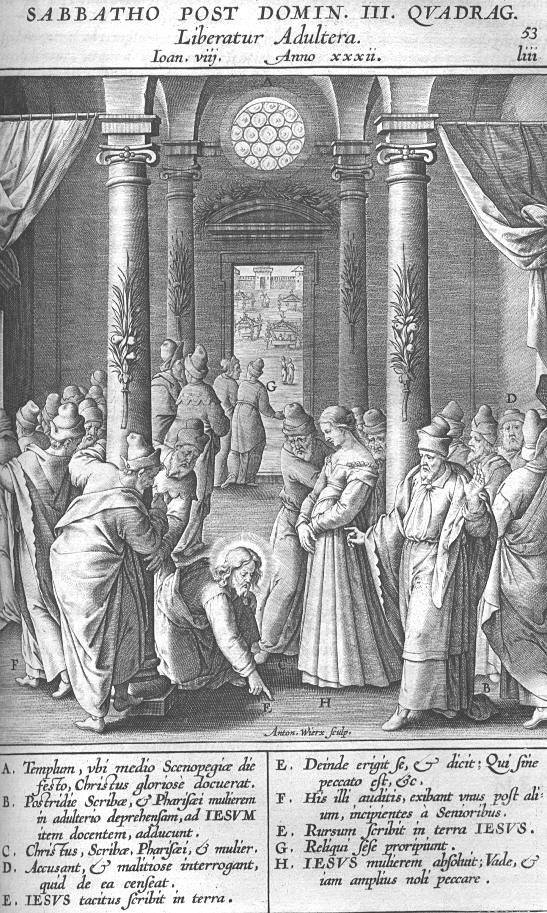
John 8:1-11
1But Jesus went to the Mount of Olives. 2At dawn he appeared again in the temple courts, where all the people gathered around him, and he sat down to teach them. 3The teachers of the law and the Pharisees brought in a woman caught in adultery. They made her stand before the group 4and said to Jesus, "Teacher, this woman was caught in the act of adultery. 5In the Law Moses commanded us to stone such women. Now what do you say?" 6They were using this question as a trap, in order to have a basis for accusing him.
But Jesus bent down and started to write on the ground with his finger. 7When they kept on questioning him, he straightened up and said to them, "If any one of you is without sin, let him be the first to throw a stone at her." 8Again he stooped down and wrote on the ground.
9At this, those who heard began to go away one at a time, the older ones first, until only Jesus was left, with the woman still standing there. 10Jesus straightened up and asked her, "Woman, where are they? Has no one condemned you?"
11"No one, sir," she said.
"Then neither do I condemn you," Jesus declared. "Go now and leave your life of sin."
During Band of Survivors, we had the awesome opportunity of working alongside the Lord and Captains Daniel and Nivia Paredes, and their staff, at the East Chicago Corps. One of the coolest aspects of their Corps (and I think most from BOS 2008 would agree), was the feeding program. Each day, people come in from the streets for a free lunch, and someone shares something from Scripture. On one such day, I shared on the above passage, which I want to share with you.Have you ever that little note at the top of this section in your Bible that says: "The earliest manuscripts and many other ancient witnesses do not have John 7:53-8:11"? I had always read it, and never knew why that was the case. Rodney Whitacre, who wrote a commentary through InterVarsity Press on John, writes:
It appears to have been a well-known story, one of many that circulated orally from the beginning yet that none of the Gospel writers were led to include. But some in the later church thought this one was too good to leave out. The controversy with the teachers of the law and the Pharisees (v. 3) is similar to stories found in the Synoptics, as is the theme of God's mercy mediated by Jesus. Those who believe that authorship is a primary criterion for canonicity will suspect or even reject this passage. Most of Christendom, however, has received this story as authoritative, and modern scholarship, although concluding firmly that it was not a part of John's Gospel originally, has generally recognized that this story describes an event from the life of Christ. Furthermore, it is as well written and as theologically profound as anything else in the Gospels. (Click here to read the source.)
That info may seem boring and unnecessary, but it's important that we know the Word, inside and out, including the history and context surrounding it.
This story is quite possibly one of the most interesting, and audacious, stories that I've ever read in the Bible. We have the Pharisees bringing in a woman that was just caught in adultery. The ridiculous thing is that they drag her in and announce this in front of everyone there (v 4). After presenting her to the crowd, and, more importantly for them, to Jesus, they ask what the correct way of dealing with her should be, especially considering what the Law has to say on the subject (i.e., you die...).
His response, not unlike many times throughout his life, would have been maddening to the accusers. The passage doesn't indicate what he wrote, but that wasn't the point. The point was that he wrote anything at all. Whitacre writes that, this being the Sabbath, Jesus was bound by Law to not write even two letters, unless they were written in the sand. Kudos to Jesus for knowing the Law, but even more than that, it reflects a deeper meaning. Whitacre sites Kenneth E. Bailey in saying that this action must have reflected the essence of Jeremiah 17:13: "O Lord, the hope of Israel, all who forsake you will be put to shame. Those who turn away from you will be written in the dust because they have forsaken the Lord, the spring of living water." Whitacre writes that this is because they themselves have rejected Jesus, and thus rejected (or forsaken) God. (Click here for to read the source.)
Ultimately, Jesus answers them by saying that if they had no sin, they then had the right to condemn and judge this woman.
The rest of this story unfolds in description: "At this, those who heard began to go away one at a time, the older ones first, until only Jesus was left, with the woman standing there."
I'm sure to her surprise, the people actually realized that they were on the same playing field as the adulterer. And, moreover, Jesus doesn't condemn her, but instead forgives her and commands her to leave her life of sin.
Ask yourself:
1. Do you try to take advantage of God's forgiveness by thinking that you can just ask for forgiveness later anyways? Read up on what true repentance is. Does it mean just saying sorry?
2. When you sin, do you bring it to God, knowing that he is faithful and just to purify you? See 1 John 1:5-9.
3. Did you know that as "leave your life of sin," you become more like Christ. That is to say that as we worship God, he makes us more like Him. Continue in your worship! See 2 Corinthians 3:18.
Posted By: Anonymous at 4:18 PM : Link : 0 Comments


